Growth plans are running into physical limits. At Climate Week NYC, we brought together voices from finance, academia, and industry to explore how Spatial Finance can help decision-makers see those limits and shape where and how capital gets deployed in the real economy.
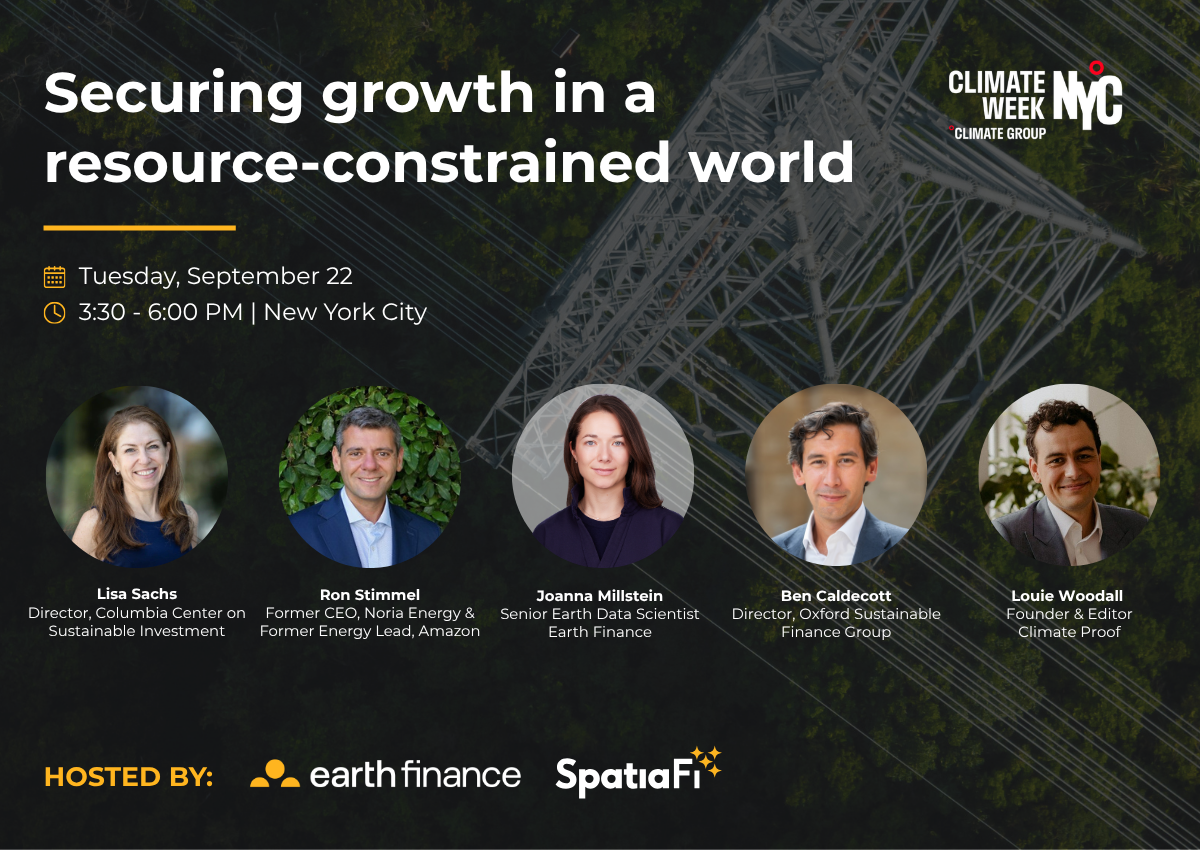
On September 22, Earth Finance hosted Securing growth in a resource-constrained world at the INK48 Hotel in New York City. Louie Woodall, Founder and Editor of Climate Proof, moderated. The panelists included:
- Lisa Sachs, Director, Columbia Center on Sustainable Investment
- Ben Caldecott, Director, Oxford Sustainable Finance Group
- Joanna Millstein, Senior Earth Scientist, Earth Finance
- Ron Stimmel, former CEO of Noria Energy and former Energy Lead at Amazon
The panel started from a shared observation that grid connections take years to secure, water basins are under strain, and much of our infrastructure was never built for the world we have today. These constraints vary sharply by location and by asset, and most traditional risk models miss them. The companies that can quantify how physical and transition risks converge, at the asset level, will be best positioned to grow in a changing world.
1. Grid capacity is the bottleneck
Ron opened with a discussion on the grid. Typically, when supply is tight, prices rise until the market balances. Today's constraint is physical, so price signals alone can't resolve it quickly.
"It's not an energy problem. We can always make more energy in the grid, but you just can't get it to where it needs to go right now." - Ron Stimmel
In energy, location is everything. Every site sits on several layers, including natural resources, physical infrastructure, policy, and economics, and sometimes even one street can change the entire business case. Ron recalled a site decision at Amazon where leasing the building across the street would have put the company in a different utility territory, with different rates, rebates, and clean energy options.
2. Physical risk cannot be an average
Joanna argued that environmental risk doesn't behave the way portfolio theory expects. Spreading it around doesn't make it smaller – physical hazards compound and escalate across the system.
Data is no longer the limiting factor. Earth observation data has grown exponentially over the past decade, so place-based analysis can now attribute risk to its underlying cause. Take a farm field in drought. The problem might be saltwater intrusion, or it might be groundwater supply, and each cause needs a different solution. As Joanna put it, "this attribution can lead to interventions."
"'Physical risk cannot be an average."'
– Joanna Millstein
3. Finance has mastered time but not place
Ben helped develop Spatial Finance as a concept at Oxford a decade ago. He defined it as the integration of geospatial data and analysis into financial theory and practice.
"Finance is all about the time machine – discount rates and thinking about time – but it's not really about place."
– Ben Caldecott
Getting financial institutions to use geospatial data has been the main barrier. Ben believes that is changing fast. AI agents that specialize in reading geospatial information are making that data easier to work with, and an idea conceptualized years ago is now "going to scale incredibly rapidly."
(At Earth Finance, we see AI as an accelerant, not the bridge itself. Today's models and agents can speed up analysis and synthesis, but linking physical and transition risk to financial modeling still depends on scientific rigor, financial economics, and human judgment. That combination is what turns geospatial data into an investment decision. Read more on our view of AI and the next chapter of Spatial Finance.)
4. The past no longer predicts the future
Financial markets largely assume the past predicts the future. Joanna noted that planetary science has spent decades modeling a world where that assumption fails. She gave an example of where physical and transition risk meet – advanced AI chips. Most are made in Taiwan, in fabrication plants that use enormous amounts of water. In 2021, a historic drought pushed reservoirs to critically low levels, and the plants had to truck in water to keep production going.
The example brings together an undiversified supply chain, a geopolitically sensitive region, and exposure to a single season of drought, all underpinning a technology buildout that is attracting unprecedented investment.
5. Risk management won't build the systems we need
Lisa argued that environmental risk frameworks and disclosure regimes have confused managing risk with building resilient systems.
"Risk management doesn't build a system. It can't. It's not even designed to."
– Lisa Sachs
A risk disclosure framework can at best tell an organization what its risks are so it can manage them. Lisa said these frameworks were promoted as a way to reshape systems, but instead they have produced a lot of data that is "neither actually useful…nor even remotely capable of building the systems to manage it."
There is also a practical limit. The rational response to higher risk is to invest less in vulnerable places, which are often where investment is needed most. Ben added that disclosure tells you "what management thinks about a particular set of issues at a given point of time." That frustration is part of what pushed his team toward encouraging the adoption of asset-level geospatial data.
The takeaway from Lisa's (self-described) controversial point of view is that spatial data is valuable for assessing risk to individual assets, and is even more valuable for planning the systems we need to build.
6. The scramble for power, land, and water is already here
Ron brought it back to the real economy with examples from the data center race:
- Land: Data center developers are outbidding other buyers by multiples. At Noria Energy, Ron's team lost a Minnesota solar site after bidding six figures against a seven-figure data center offer.
- Power: PJM capacity auction prices rose several-fold in a single year.
- Water: Not every facility uses closed-loop cooling, and much of the water footprint is hidden upstream in energy generation and chip manufacturing.
Lisa noted that the same geospatial data a hyperscaler uses to find land, water, and power could also inform how those finite resources are allocated across all users, beyond any single entity.
Understanding the true cost of doing business
Earth Finance CEO Garrett Kephart closed the event with a simple point. Financial planning has long assumed water and power will be available when needed, at a price companies can pay. That assumption is breaking down.
"When companies can confidently quantify the convergence of physical and transition risks at specific locations, at an asset level, they're going to be best positioned to weather all this change." – Garrett Kephart
That's why we launched SpatiaFi Energy, the first offering on SpatiaFi, Earth Finance's Spatial Finance platform. As Garrett put it, "the era of guaranteed power is over." SpatiaFi Energy combines a company's location data with current utility and grid information to show where electricity supply, price, and carbon intensity create risk or opportunity. It quantifies the cost of action and inaction and helps teams prioritize which actions are worth taking.
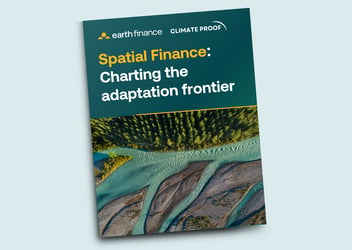
Want to go deeper? Read our white paper with Climate Proof, Spatial Finance: Charting the adaptation frontier, on how Spatial Finance can create competitive advantage across the energy-water-food nexus.