Powered by SpatiaFi, a geospatial intelligence platform built on Google Cloud
Challenge
Energy security and independence is rapidly emerging as a core business risk for companies with large physical footprints. For this commercial retailer, the issue first surfaced during an earlier scenario planning and a double materiality assessment. However, what initially appeared to be a sustainability issue quickly revealed deeper operational implications.
The company has ambitious plans to open dozens of new sites by 2030 while achieving 100% clean energy in operations. Unfortunately, rapidly evolving electricity markets were challenging those plans.
In several cases, energy constraints had already begun to disrupt development timelines. Utilities were unable to provide sufficient power for new sites on schedule, forcing the company to consider alternatives. Some locations required unexpected investment in onsite solar generation and storage to open on time. These installations had not been included in original project budgets, significantly increasing CapEx and undermining return on investment (ROI) assumptions behind margin-sensitive new developments. In other cases, onsite generation proved too costly, forcing the company to abandon otherwise economically viable locations.
Energy security – including availability, price, and carbon impact – was reshaping the economics of where and how the retailer could grow.
The stakes were significant. The retailer deploys billions of dollars annually to open new sites, and as the business expands, electricity demand across its portfolio could increase nearly 50% by 2035. At the same time, increasingly limited clean energy availability was complicating efforts to meet corporate sustainability targets.
Despite the urgency, the company faced several structural barriers to solving the problem internally:
Relevant information, such as transmission capacity, electricity prices, and reliability, existed across multiple sources but was not organized in ways that business teams could use. For instance, energy specialists might analyze transmission lines in Google Earth, but that information did not flow or translate easily into actionable guidance for real estate teams selecting new sites.
Energy teams often relied on local utilities for insights into grid capacity or future infrastructure upgrades. These inputs were not always consistent or reliable, making it difficult to build confidence in the ROI of the company’s growth plans.
The energy team typically became involved in the site selection process during the design and permitting phase – long after a location had already been chosen.
With hundreds of potential new sites under consideration, existing teams lacked the resources to conduct detailed energy feasibility analyses for every location, resulting in delayed response times.
Relevant information, such as transmission capacity, electricity prices, and reliability, existed across multiple sources but was not organized in ways that business teams could use. For instance, energy specialists might analyze transmission lines in Google Earth, but that information did not flow or translate easily into actionable guidance for real estate teams selecting new sites.
Energy teams often relied on local utilities for insights into grid capacity or future infrastructure upgrades. These inputs were not always consistent or reliable, making it difficult to build confidence in the ROI of the company’s growth plans.
The energy team typically became involved in the site selection process during the design and permitting phase – long after a location had already been chosen.
With hundreds of potential new sites under consideration, existing teams lacked the resources to conduct detailed energy feasibility analyses for every location, resulting in delayed response times.
The company needed a way to understand the financial implications of energy security risk across its portfolio, and to integrate those insights into earlier stages of growth planning.
Our approach
Earth Finance partnered with the retailer to assess energy risks across existing and planned sites, quantify their financial impacts on the business, and develop a resilience strategy to address them. The work combined econometric modeling with geospatial analytics from
, Earth Finance’s geospatial intelligence platform built on Google Cloud.
1) Establishing energy data governance. The first phase focused on aligning internal processes and improving how energy information flowed across teams. Energy risk sits at the intersection of real estate, construction, sustainability, and energy procurement. Historically, these groups worked in siloes, which meant electricity constraints were often discovered after the site had already been selected.
We worked with the organization to redesign this process so that energy data could be introduced earlier, allowing teams to proactively manage electricity supply, price, and carbon risk.
2) Analyzing site-level energy risk across the portfolio. The next phase assessed energy security risks across the company’s real estate footprint, covering hundreds of existing and planned sites. To support this work, we doubled the SpatiaFi data catalogue to include 500+ energy-related geospatial layers across the United States. These included electricity prices, grid reliability data, transmission expansion forecasts, data center-driven electricity demand, regional power generation trends, and more.
Using these datasets, we developed a scoring framework that evaluated each site across 3 dimensions:
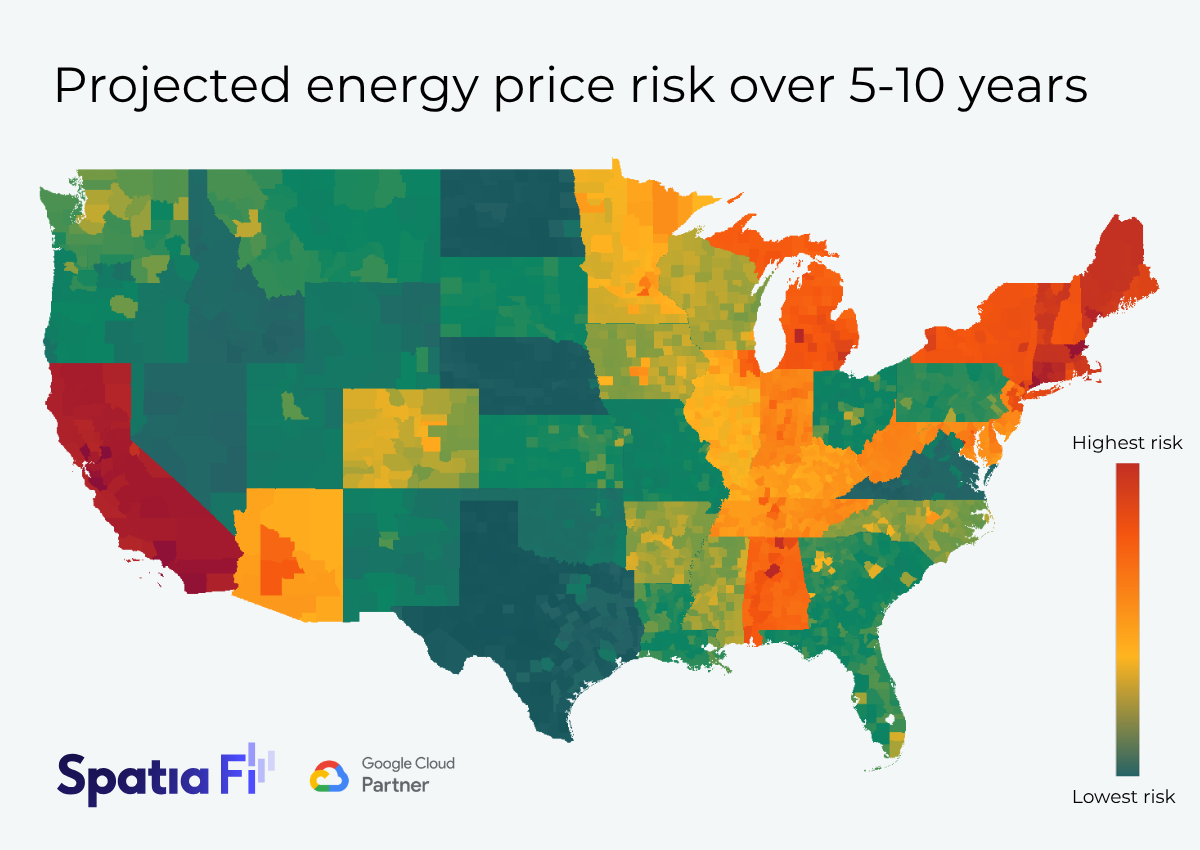
- Energy price risk evaluated how electricity costs may change over time based on regional market trends and projected generation costs.
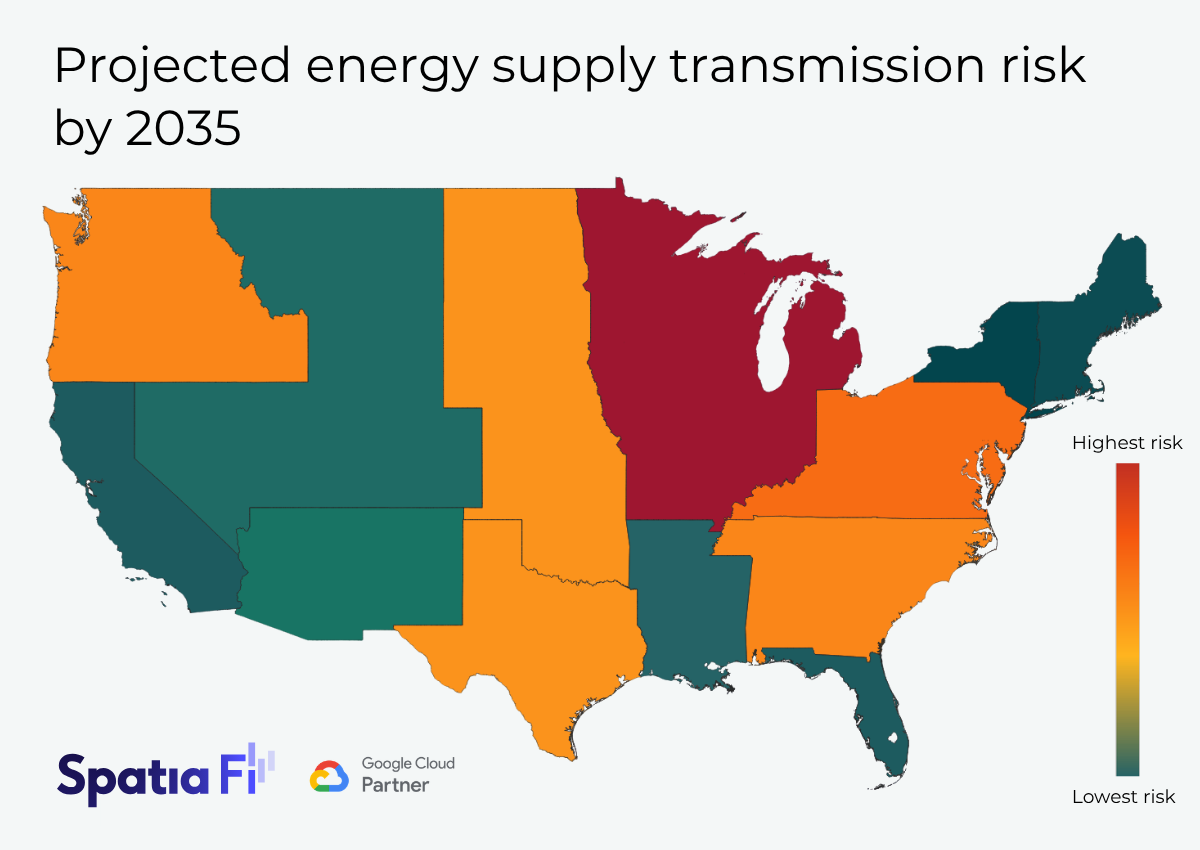
- Energy supply risk: captured whether electricity would be available where and when it was needed using indicators such as outage frequency, reserve margin risk, transmission adequacy, and data center competition.
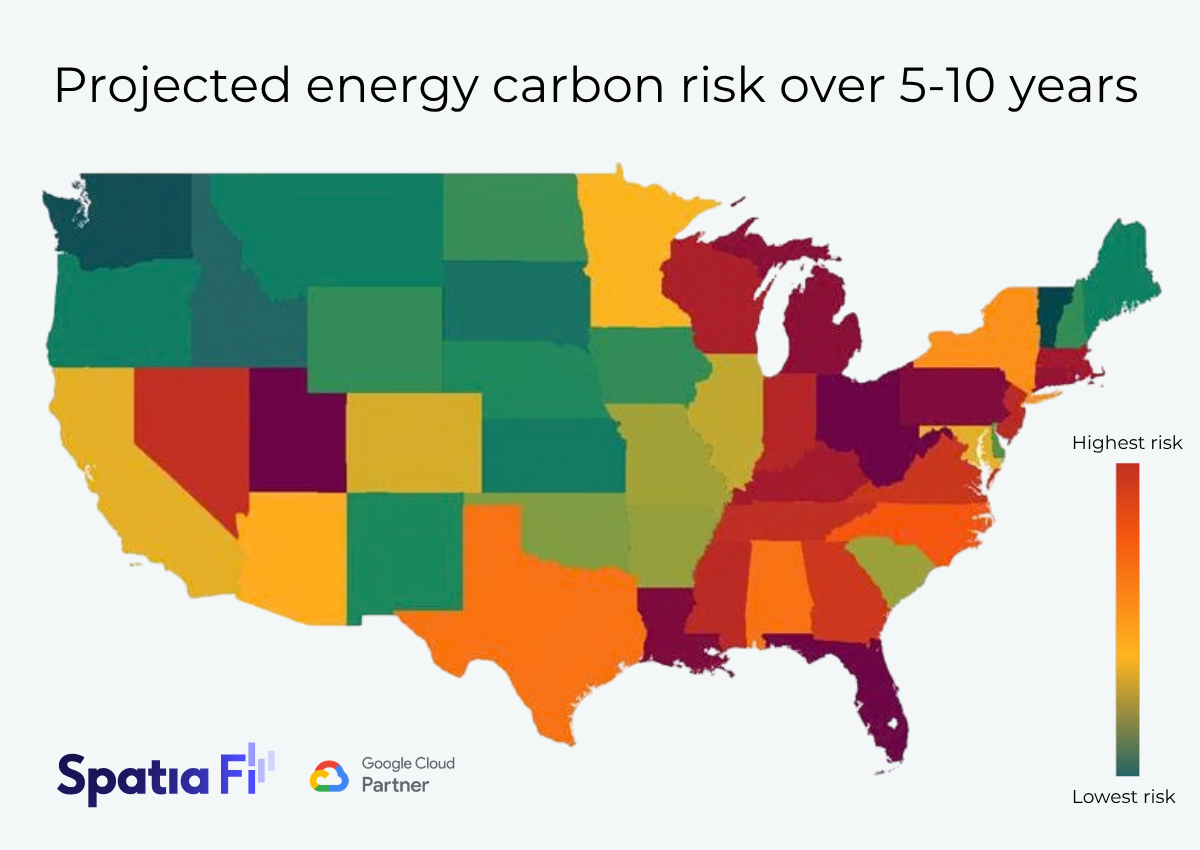
- Carbon risk: assessed whether sites could access low-carbon electricity from the grid today and how that trajectory might change through 2035.
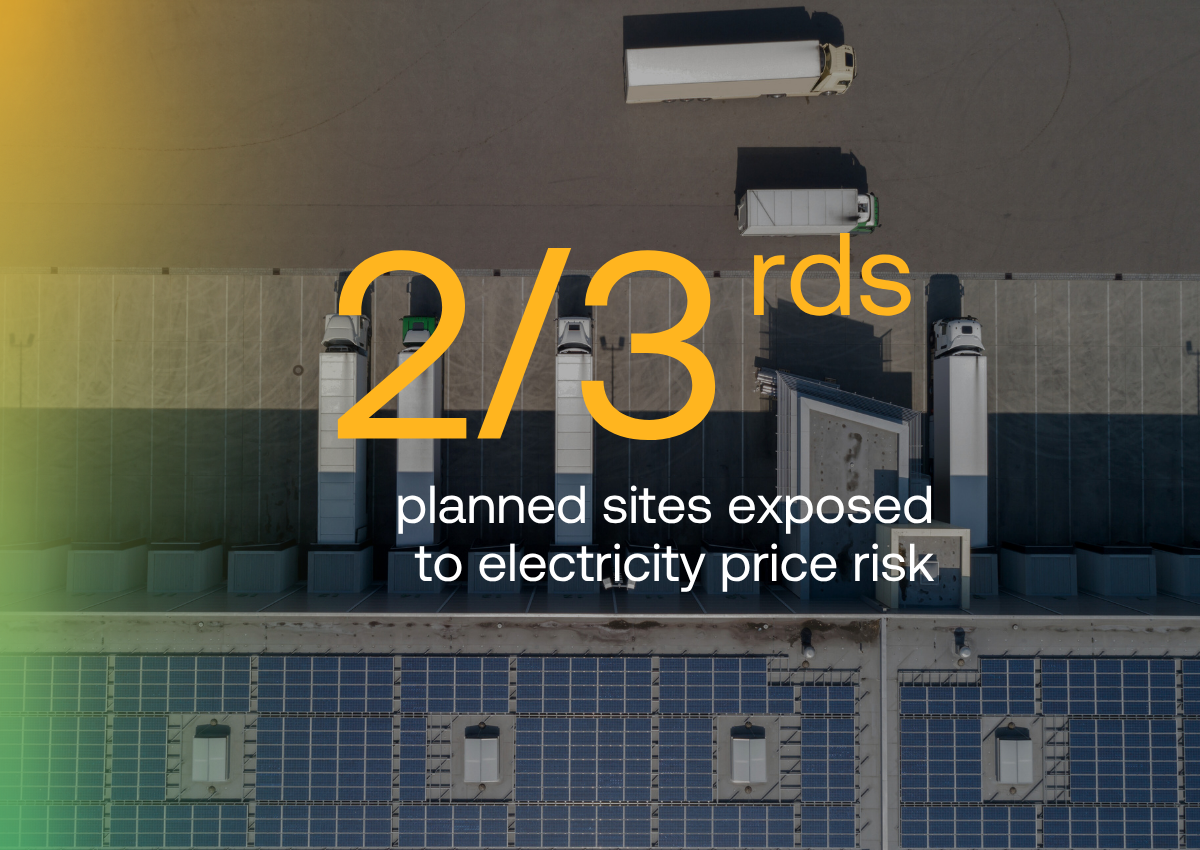
Together, these indicators produced a site-level energy security profile that could be compared across the company’s entire real estate footprint. For example, our analysis revealed that over 2/3rds of planned sites are exposed to medium or high electricity price risk.
3) Quantifying financial exposure. To translate these risks into business terms, Earth Finance developed a bespoke econometric model to quantify potential financial impacts on the business.
The model incorporated uncertainty modeling to assess how rising emissions, electricity reliability, and utility price shifts could affect the company’s operating costs.
For example, under a high-emissions scenario, we found that U.S. locations could experience more than 20% growth in cooling degree days by 2030, leading to significant increases in electricity consumption. Combined with projected utility rate changes and reliability risks, this scenario could result in tens of millions in additional utility costs per year.
Cooling degree days: A closer look
Refrigeration and HVAC loads are a major driver of electricity demand for any retailer with cold chain storage facilities. Our team analyzed facility-level energy use and ran regression analysis against historical cooling degree days to project rising utility costs as temperatures rise. By combining these insights with solar irradiance and regional grid emissions data, the analysis also identified where onsite solar and storage could most effectively offset cooling demand and site-level emissions.
4) Designing an adaptation and resilience strategy. The final phase focused on turning these insights into practical interventions. We presented the results to C-suite executives from sustainability, construction, real estate, and distribution and held follow-up sessions with operational teams.
Proposed interventions to strengthen energy resilience included earlier engagement with utilities during site selection, site-level risk profiles to help teams identify electricity constraints, and onsite generation and storage to address supply, price, and carbon risks. Our analysis also highlighted regions best positioned to support clean energy procurement goals and where onsite generation could deliver the strongest ROI relative to the grid.
Part of this process involved engaging individual operational teams to continue reinforcing a culture of collaboration around energy data and decision-making in site selection.
Project outcomes
This project allowed the retailer to treat energy security as a core business issue. Teams now have a clearer understanding of how energy could affect long-term growth strategy, capital allocation, and operational costs – backed by robust insights across their entire real estate portfolio.
Key wins and findings
Hundreds of sites
Existing and planned locations analyzed for energy risk
2 out of 3
Planned sites facing exposure to electricity price increases
4 out of 5
Planned sites unlikely to contribute to near-term sustainability targets
Tens of millions
Potential increase in annual utility costs by 2030 under a high emissions scenario
This engagement laid the foundation for the company to:
- Begin integrating energy security considerations into its growth strategy.
- Assess energy risk earlier in the site selection process.
- Facilitate stronger collaboration between energy, real estate, construction, and sustainability teams.
- Engage utilities and engineering partners with data-backed insights.
- Build greater confidence in ROI assumptions behind new site development.
Moving forward, the company is exploring integrating SpatiaFi energy data and analytics directly into internal planning workflows. By bringing energy analysis forward in the site selection process, the organization can avoid costly delays, protect the ROI of new investments, and make more informed decisions about where and how to grow.
Safeguarding growth in an energy-constrained world
As electricity systems evolve and demand accelerates, companies expanding physical infrastructure must understand how location-specific energy risks affect business strategy and growth. Spatial analysis and financial modeling allow organizations to move from reactive problem-solving to proactive planning.
Interested in learning how energy security impacts your organization? Earth Finance helps companies financially quantify risks and develop spatially informed energy security strategies that support growth and sustainability goals.