
How to build energy security in ports with a low-carbon fuel that's available today
Nearly every vehicle operating in US ports, including harbor vessels, tugboats, cargo handling equipment, locomotives, and drayage trucks, runs on petroleum diesel. With escalating geopolitical disruptions and volatile crude markets, that dependence is becoming a vulnerability.
However, it also presents an opportunity. With relatively little upfront investment, ports can simultaneously increase regional energy security and reduce greenhouse gas (GHG) emissions by switching to renewable diesel.
Pockets of momentum are already developing. Bolstered by Clean Fuel Standard (CFS) policies on the West Coast, organizations like Husky Terminal and SSA Marine have begun adopting renewable diesel voluntarily. In Tacoma, significant infrastructure investments from TransMontaigne Partners have made the SeaPort Sound Terminal one of the largest renewable diesel terminals in Washington state. California has gone a step further, with the state’s Commercial Harbor Craft regulation now mandating renewable diesel for many harbor vessels. Internationally, the EU and parts of Asia Pacific have set more stringent maritime emissions standards.
However, despite renewable diesel’s economic and environmental benefits, its use in US ports remains relatively low beyond these regional bright spots. Read on to learn why renewable diesel is such a compelling fit for ports and a few strategies for accelerating its use nationwide.
The case for renewable diesel in ports
Renewable diesel is one of the most widely applicable low-carbon fuels across the transportation sector, but is especially well suited for ports and heavy-duty transportation. Here’s why the use case is so compelling:
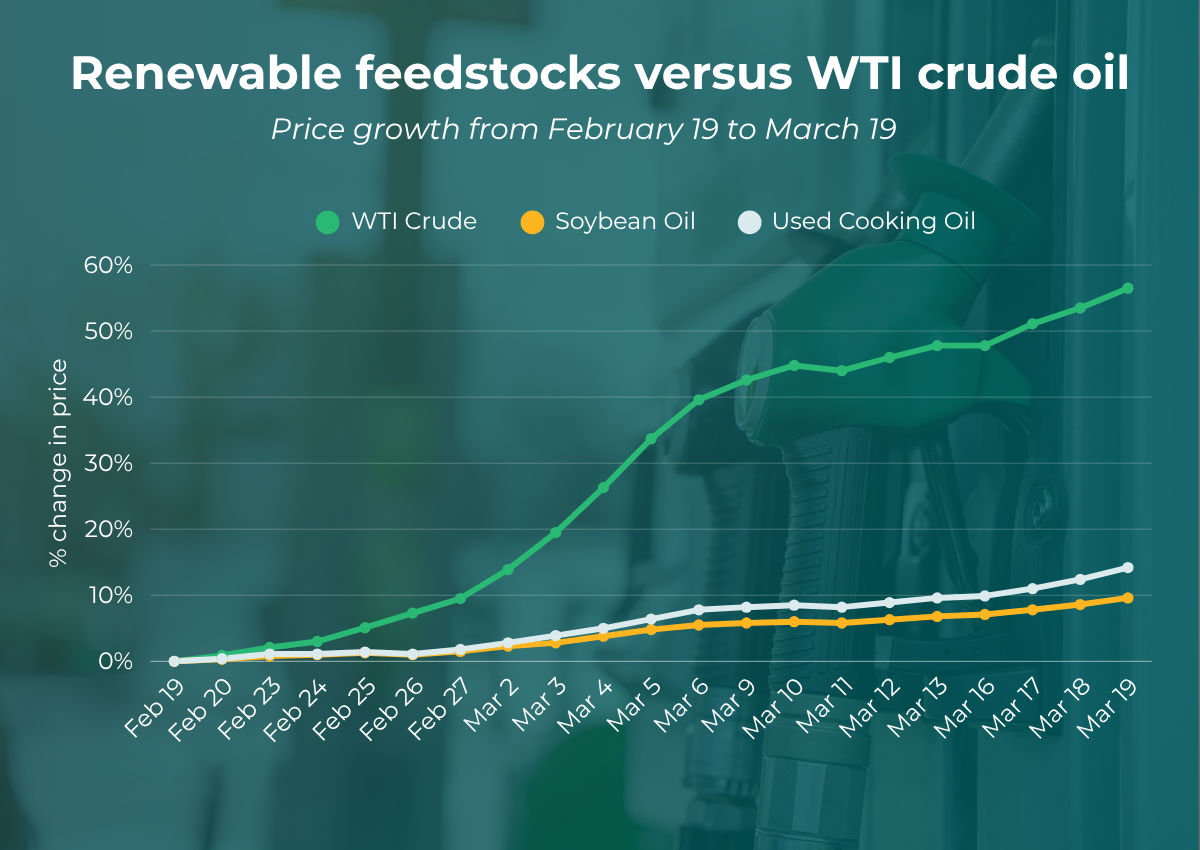
The geopolitical turbulence of 2026 has made energy security impossible to ignore. For example, since the Strait of Hormuz disruptions, WTI crude oil prices surged by nearly 60% between February and March. Over that same period, the feedstocks used to produce renewable diesel, such as soybean oil and used cooking oil, increased by less than 15%.
Petroleum-based fuels are structurally exposed to geopolitical shocks in ways that renewable feedstocks are not. That’s because renewable diesel feedstocks are sourced locally and not pegged to global crude markets. Future pathways using waste oils, woody biomass, and agriculture waste will expand this advantage further.
Unlike alternative fuels that require new engines, new infrastructure, or fleet-wide capital expenditures, renewable diesel is a true drop-in replacement. It is ASTM D975-certified, chemically identical to petroleum diesel, and compatible with every existing diesel engine. That means ports can boost energy security and decarbonization without disruption to operations or the years-long lead times that electrification or hydrogen conversions demand.
Ports are emissions-dense environments. Diesel-powered equipment operating in close proximity to residential communities produces significant volumes of diesel particulate matter (DPM), a known carcinogen, along with SOx and NOx that degrade regional air quality. Renewable diesel significantly cuts these pollutants while reducing overall lifecycle CO2 emissions by up to 80%, delivering a tangible public health benefit to surrounding communities.
Fully electrifying ports would require massive capital outlays for grid infrastructure and charging systems. Even then, the grid may not be able to handle the additional load for years, and recent cancellations of renewable energy projects add further uncertainty to clean electricity timelines. Renewable diesel delivers deep emissions reductions today while the grid modernizes over time.
Renewable diesel burns cleaner than petroleum diesel, producing less diesel particulate matter. That translates to fewer diesel exhaust fluid (DEF) filter changes, fewer diesel particulate filter replacements, and lower overall maintenance costs. One analysis finds maintenance and repair savings can reach as much as $0.23 per mile for heavy-duty port vehicles running on 99% renewable diesel.
The geopolitical turbulence of 2026 has made energy security impossible to ignore. For example, since the Strait of Hormuz disruptions, WTI crude oil prices surged by nearly 60% between February and March. Over that same period, the feedstocks used to produce renewable diesel, such as soybean oil and used cooking oil, increased by less than 15%.
Petroleum-based fuels are structurally exposed to geopolitical shocks in ways that renewable feedstocks are not. That’s because renewable diesel feedstocks are sourced locally and not pegged to global crude markets. Future pathways using waste oils, woody biomass, and agriculture waste will expand this advantage further.
Unlike alternative fuels that require new engines, new infrastructure, or fleet-wide capital expenditures, renewable diesel is a true drop-in replacement. It is ASTM D975-certified, chemically identical to petroleum diesel, and compatible with every existing diesel engine. That means ports can boost energy security and decarbonization without disruption to operations or the years-long lead times that electrification or hydrogen conversions demand.
Ports are emissions-dense environments. Diesel-powered equipment operating in close proximity to residential communities produces significant volumes of diesel particulate matter (DPM), a known carcinogen, along with SOx and NOx that degrade regional air quality. Renewable diesel significantly cuts these pollutants while reducing overall lifecycle CO2 emissions by up to 80%, delivering a tangible public health benefit to surrounding communities.
Fully electrifying ports would require massive capital outlays for grid infrastructure and charging systems. Even then, the grid may not be able to handle the additional load for years, and recent cancellations of renewable energy projects add further uncertainty to clean electricity timelines. Renewable diesel delivers deep emissions reductions today while the grid modernizes over time.
Renewable diesel burns cleaner than petroleum diesel, producing less diesel particulate matter. That translates to fewer diesel exhaust fluid (DEF) filter changes, fewer diesel particulate filter replacements, and lower overall maintenance costs. One analysis finds maintenance and repair savings can reach as much as $0.23 per mile for heavy-duty port vehicles running on 99% renewable diesel.
Price growth of renewable diesel feedstocks versus WTI crude oil driven by Strait of Hormuz disruptions, with % growth indexed to 0 on February 19. Data calibrated to USDA, WASDE, EIA, and ASA March 2026 anchor points.

Despite its advantages, renewable diesel adoption in ports outside the West Coast remains low. A few structural barriers need to be addressed to increase adoption and narrow the gap outside the West Coast:
1) Supply infrastructure and transportation costs. Petroleum diesel benefits from a national supply network built over a century. Renewable diesel, by contrast, is typically transported by barge, rail and truck, which can add significant logistics costs. In states without market-based mechanisms, the added costs can make renewable diesel substantially more expensive than conventional diesel – suppressing demand in a self-reinforcing cycle. Even in Washington, which passed a Clean Fuel Standard in 2021, the state’s isolation from the major US interstate petroleum pipeline network subjects it to further price volatility.
2) Misconceptions about the fuel. Many port operators and fleet managers conflate renewable diesel with biodiesel. While concerns associated with biodiesel are valid, such as gelling, biocontamination, and engine incompatibility, they aren't applicable to renewable diesel. Still, the misconception persists, and the confusion between the two remains one of the largest barriers to renewable diesel adoption.
Renewable diesel vs. Biodiesel
Renewable diesel is a hydrocarbon and is chemically identical to petroleum diesel. It meets ASTM D975 specifications and can be used as a 100% drop-in replacement. Biodiesel, by contrast, is a fatty acid methyl ester (FAME) – not a hydrocarbon or diesel. It can gel at lower temperatures, become a biocontamination risk in marine environments, and may require engine modifications – all of which increase capital costs and operational complexity.
3) Regional supply volatility. Imbalanced clean fuel markets can concentrate production and adoption in certain regions. In Washington, for example, due to the program only being in effect for 3 years, clean fuel credit prices have not been as competitive as those in longer-standing programs in Oregon and California, incentivizing producers to ship renewable diesel south rather than serve the local market. The Washington Legislature has since tightened the program under HB 1409 to make credit prices more competitive in the coming years.
Strategies to accelerate renewable diesel adoption
Overcoming these barriers requires coordinated action across the port ecosystem. The following strategies offer a practical path forward for port authorities, fleet operators, and regional stakeholders.
1) Aggregate demand across port end users
A single fleet operator switching to renewable diesel may not generate enough volume to justify a reliable supply chain. But a port is a concentrated demand center, with harbor vessels, cargo handling equipment, drayage trucks, and rail locomotives all burning diesel within the same geographic footprint.
By coordinating across these end users, port authorities can aggregate demand and structure a sizable and bankable offtake agreement – a contractual commitment to purchase a set volume of fuel over a defined period. Offtake agreements send the demand signals that producers and distributors need to justify allocating supply to a new region.
For instance, a pilot program coordinated by a trusted non-profit or port authority could convene all fuel consumers at a given port, or even across multiple ports in the same region, to negotiate a single offtake agreement with a regional distributor. This reduces per-unit transportation costs, provides the volume certainty producers need, and creates a replicable template for other ports.
2) Advocate for supportive policies at the state and national level
At the state level, Clean Fuel Standards are one of the most powerful policy mechanisms for driving renewable diesel adoption. By creating a market-based mechanism that rewards low-carbon fuels, CFS policies help close the price gap between renewable and petroleum fuels. In more mature clean fuels markets, these policies have made renewable diesel cheaper than fossil diesel. In California, for example, renewable diesel has cost an average of 10 cents less per gallon over the past 8 years and makes up over 70% of all diesel sold in the state.
For ports in states without a CFS, building a cross-sector coalition to advocate for state-level clean fuel policies or mandates is one of the highest-leverage actions available.
Coalition building can also address the practical infrastructure gaps that limit supply. In some states, expanding renewable diesel supply may require additional tankage at fuel terminals, which in turn may require local governments to revise permitting caps on petroleum storage assets. This kind of regulatory coordination is where coalitions become essential.
At the federal level, stakeholders can advocate for amendments to the Renewable Fuel Standard (RFS). Under the current standard, ocean-going vessels using renewable diesel cannot generate renewable identification numbers (RINs), preventing them from capturing the financial benefits of the program. This creates a substantial price differential between waterfront and road use of the same fuel. Advocating for legislative changes that extend RFS eligibility to maritime would help drive price parity with road transportation users.
3) Enlist original equipment manufacturers as educators
The most credible messenger for an end user uncertain about switching fuels is the company that built the engine. Original equipment manufacturers (OEMs), the makers of tugboat engines, cargo cranes, drayage trucks, and locomotives, can address skepticism in ways that policy briefs and marketing materials cannot.
For example, a port authority could partner with major OEMs to develop a targeted education campaign for port fleet operators, combining warranty documentation, maintenance cost data, and testimonials from ports that have already adopted renewable diesel. These communications should emphasize the transition as a cost-reduction strategy and not just a sustainability play by quantifying maintenance savings and emphasizing that engine warranties are honored when using renewable diesel.
Renewable diesel is an energy security strategy
Renewable diesel is not an emerging technology. It is a commercially viable drop-in solution that significantly reduces lifecycle emissions while promoting regional energy security in an era of geopolitical volatility.
The ports that act early – by aggregating demand, advocating for supportive policy, and working with OEMs to educate end users and regional stakeholders – will enjoy lower fuel costs, healthier communities, and a more resilient energy supply chain. What's needed now is coordination.
Earth Finance's renewable fuels practice helps port authorities, fuel producers, and transportation stakeholders develop strategies to accelerate the adoption of lower-carbon fuels like renewable diesel. Get in touch to explore how we can support your organization.