
How a value chain assessment is helping one of the Pacific Northwest’s largest ports chart a path to deep emissions reductions
Challenge
The Port of Seattle, Port of Tacoma, and Northwest Seaport Alliance share an ambitious commitment to phase out all seaport-related air pollution and greenhouse gas (GHG) emissions by 2050. Historically, electrification has been the desired pathway to achieve this goal, as Washington state has some of the cheapest and cleanest electricity in the country thanks to its abundant, low-cost hydropower.
Unfortunately, the infrastructure to support full electrification of port operations isn’t yet available. Charging systems for harbor vessels, cargo handling equipment, and drayage fleets require massive capital outlays and years-long lead times.
The Port of Seattle isn’t giving up on electrification, but leadership recognized the need for a transition strategy that could deliver deep emissions reductions now while the economics and infrastructure for electrification mature. Renewable diesel, a drop-in replacement for petroleum diesel that requires no engine modifications and can reduce lifecycle GHG emissions by up to 80%, emerged as a promising candidate.
However, the Port faced several structural barriers that added complexity to a full transition to renewable diesel:
Washington’s clean fuel credit prices have not been as competitive as those in Oregon and California, incentivizing producers to ship finite renewable diesel supplies south rather than serve the local market. This created an inconsistent supply and higher per-gallon costs for Washington buyers like the Port of Seattle.
Across the value chain, renewable diesel is routinely conflated with biodiesel. While biodiesel gels at lower temperatures, can create biocontamination risks in marine environments, and requires engine modifications, renewable diesel has none of these issues. It is chemically identical to petroleum diesel and meets ASTM D975 specifications.
Harbor Island, the primary hub for marine fuel distribution in the Port of Seattle, lacks the rail systems, pipeline access, and deep-water dock infrastructure needed to receive and store renewable diesel at scale. Building dedicated storage would require conditional use permits – an investment producers were unwilling to make without guaranteed demand.
No single port in Washington generates enough renewable diesel demand to justify the infrastructure investment on its own. Fuel use across harbor craft in Puget Sound is spread across multiple vessel classes, operators, and fueling arrangements, none of which is organized into the kind of aggregated, long-term commitment that would unlock supply.
Washington’s clean fuel credit prices have not been as competitive as those in Oregon and California, incentivizing producers to ship finite renewable diesel supplies south rather than serve the local market. This created an inconsistent supply and higher per-gallon costs for Washington buyers like the Port of Seattle.
Across the value chain, renewable diesel is routinely conflated with biodiesel. While biodiesel gels at lower temperatures, can create biocontamination risks in marine environments, and requires engine modifications, renewable diesel has none of these issues. It is chemically identical to petroleum diesel and meets ASTM D975 specifications.
Harbor Island, the primary hub for marine fuel distribution in the Port of Seattle, lacks the rail systems, pipeline access, and deep-water dock infrastructure needed to receive and store renewable diesel at scale. Building dedicated storage would require conditional use permits – an investment producers were unwilling to make without guaranteed demand.
No single port in Washington generates enough renewable diesel demand to justify the infrastructure investment on its own. Fuel use across harbor craft in Puget Sound is spread across multiple vessel classes, operators, and fueling arrangements, none of which is organized into the kind of aggregated, long-term commitment that would unlock supply.
Before committing to a renewable diesel strategy, the Port needed to understand whether the market could actually support one, and what pain points existed across the entire fuel value chain.
Our approach
Earth Finance partnered with the Port of Seattle to conduct a comprehensive market assessment of the renewable diesel landscape in the Puget Sound region. The goal was to move beyond assumptions and build a strategy grounded in the perspectives of every stakeholder along the fuel value chain. Here’s a closer look at our process:
1) Landscape assessment of the existing fuel ecosystem. We began with a full landscape assessment to understand the infrastructure, refinery capacity, policy environment, and supply chain dynamics shaping the renewable diesel market in Washington state.
This included in-depth conversations with 25 stakeholders spanning every link in the fuel value chain: fishing fleet operators, tugboat and tow companies, fuel distributors, refineries, bunkering entities, ports in California that had already transitioned harbor craft fuels under state mandates, the Washington Department of Ecology, and non-profit organizations involved in clean fuel advocacy.
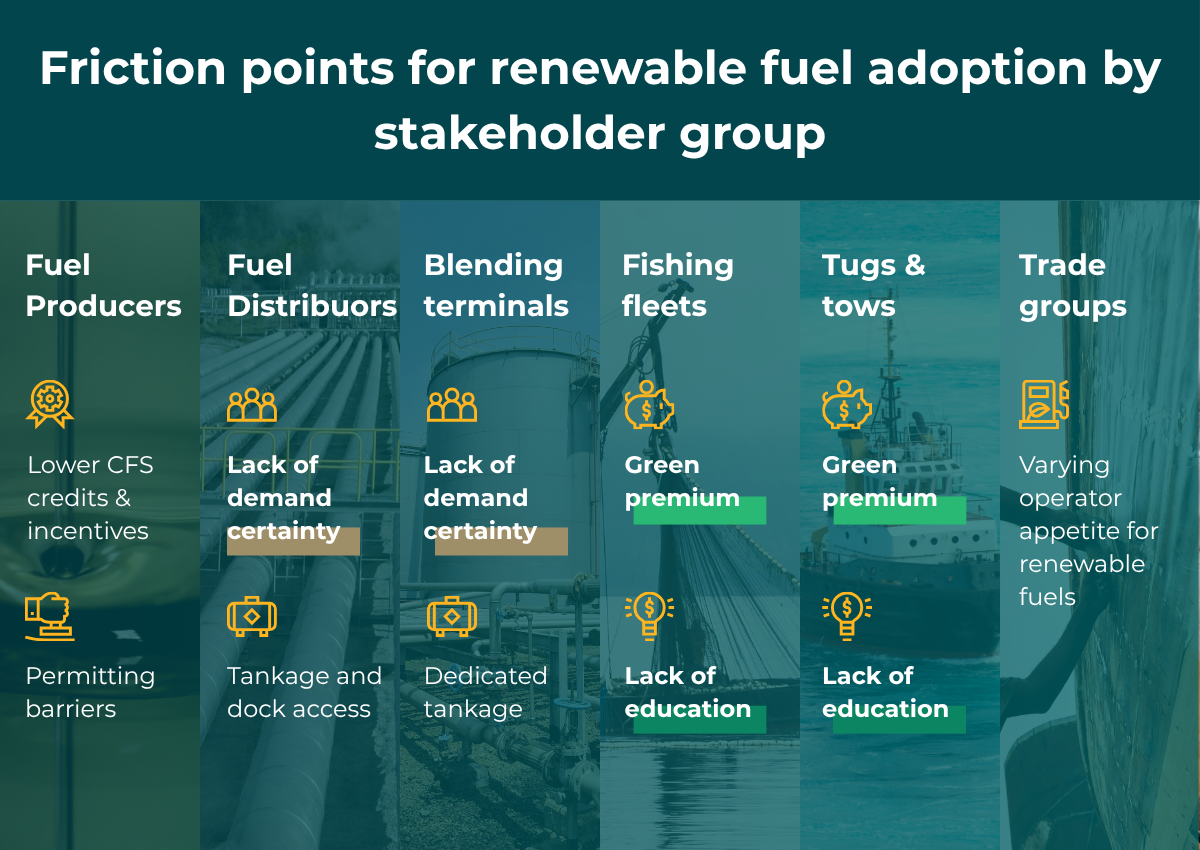
2) Identification of common pain points across stakeholder categories. We then synthesized the results of these conversations and identified friction points specific to each constituency to determine what barriers needed to be addressed to scale renewable diesel adoption.
One learning that surfaced through our conversations was that misconceptions around renewable diesel were prevalent across the entire value chain. For instance, many fuel producers and distributors weren’t familiar with the fuel's benefits or how state-wide Clean Fuel Standard (CFS) policies could offset its cost, while end users feared that switching to renewable diesel would void their engine warranties.
Another learning was that a one-size-fits-all approach for fuel policy in ports likely won't work because harbor vessels have vastly different operational profiles. Alaska-bound fishing boats, for example, are far more concerned about fuel gelling in cold weather than tugboats moving tankers around a temperate harbor.
Summary of Earth Finance analysis of priorities and perceptions of renewable diesel by value chain node – based on in-depth interviews with 25 entities.
3) Prioritization of recommendations. Based on the pain points identified for each stakeholder group, we developed a set of recommendations tailored to what the Port of Seattle could realistically influence and execute.
One of the single highest-impact interventions identified was addressing the pervasive knowledge gaps across producers, distributors, and end users. A coordinated, OEM-backed education campaign targeting each constituency with relevant, credible information about the benefits of renewable diesel would remove one of the largest barriers to adoption.
We also recommended that the Port of Seattle aggregate demand across the region. Harbor craft in the Puget Sound consume approximately 53 million gallons of diesel fuel annually – well above the 5 million gallons that producers and distributors commonly cited as the minimum threshold to justify investment in renewable diesel. In other words, if just a fraction of harbor craft switched to renewable diesel, producers and distributors would be well incentivized to invest in the necessary supply and infrastructure.
The problem is that no single operator generates enough volume, and no mechanism exists to pool demand across vessel classes and operators into the kind of bankable, multi-year offtake agreement that would unlock investment. Breaking this cycle would require multimodal demand aggregation using harbor craft as an entry point for other port-adjacent diesel consumers like drayage trucks and cargo handling equipment.
As part of this workstream, we spelled out how a regional demand aggregation strategy might take shape, perhaps partnering with an entity like Washington State Ferries, which operates the largest ferry system in the US and burns 19 million gallons of diesel fuel per year.
Project outcomes
The Port of Seattle now has a robust understanding of the regional fuel market and a clear execution framework for transitioning harbor vessel operations to renewable diesel – the first critical step toward dramatically reducing the port’s carbon footprint from maritime activity.
Key wins and findings
25
Value chain stakeholders interviewed in depth
53 million
Gallons of diesel consumed annually in Puget Sound
450,000
Metric tons of CO₂e avoided under a full renewable diesel transition
3,600
Commercial vessels registered in the Puget Sound area
This engagement laid the foundation for the Port of Seattle to:
- Align with 2050 Clean Air Strategy goals despite headwinds on electrification.
- Reduce GHG emissions in the near term by up to 70-80%.
- Lower exposure to unhealthy emissions from diesel combustion, delivering tangible benefits to human health.
- Develop a coordinated regional offtake signal large enough to unlock supply.
- Increased stakeholder confidence in renewable diesel through value chain-wide engagement.
Going forward, the Port is considering how to sequence and execute these recommended strategies, including a pilot program to test renewable diesel in specific harbor craft and provide the quantitative metrics needed to justify broader adoption.
Earth Finance’s renewable fuels practice helps port authorities, fuel producers, and transportation stakeholders develop strategies to accelerate the adoption of lower-carbon fuels like renewable diesel. Get in touch to explore how we can support your organization.