The challenge of SAF
Transitioning to sustainable aviation fuel (SAF) is critical to decarbonizing the aviation industry. To put the sector on a path to full decarbonization by 2050, the US government launched the SAF Grand Challenge, which includes an ambitious commitment to meet 100% of fuel demand with SAF by 2050 and produce 3 billion gallons of SAF per year by 2030.
However, there are sizeable barriers to making SAF a viable market alternative to conventional jet fuel. On the production side, SAF supply is limited by lack of financing, supportive policy, feedstock availability, infrastructure and transportation challenges, and gaps in technology. On the deployment side, airlines and other jet fuel users struggle to justify SAF’s green premium in an industry with razor-thin margins and cost-sensitive customers. In addition, securing offtake agreements and reworking supply chains to incorporate SAF into their distribution systems requires enormous investment of resources and capital.
Policymakers, airlines, and other value chain stakeholders have implemented a variety of solutions to help ease these barriers. For instance, research institutions are advancing the technology readiness level (TRL) of specific feedstocks and SAF production pathways, and airlines are pre-purchasing SAF via offtakes in partnership with corporations seeking Scope 3 credits.
Limitations of current solutions
Despite these interventions, SAF accounts for just over half a percent of aviation fuel production today. The problem is that barriers and solutions vary by region – to meaningfully accelerate SAF production, solutions and interventions need to be translated into a geographic context.
Unlike fossil jet fuel, which has a relatively conventional refining process, there’s no standard recipe for scaling SAF production. Each region brings its own comparative advantages and challenges, and solutions will look different depending on the feedstocks, technologies, policies, and infrastructure available.
For instance, in some parts of the world, the predominant regional feedstock may be fats, oils, and greases, meaning HEFA is the most logical SAF production pathway, whereas regions abundant in woody biomass may use the Fisher-Tropes production pathway. The value chains for these two feedstocks and production pathways will require unique sets of solutions to scale SAF regionally.
Another problem is that current solutions usually only focus on one dimension of the SAF ecosystem. Transitioning to SAF means embracing a systems-level approach. Stakeholders must thoughtfully prioritize and map out how each pillar of systemic change – supportive policy, feedstock and energy availability, infrastructure, financing, and research and development – will impact the others.
Cascadia Sustainable Aviation Accelerator (CSAA)
A new model for accelerating the SAF transition in the Pacific Northwest
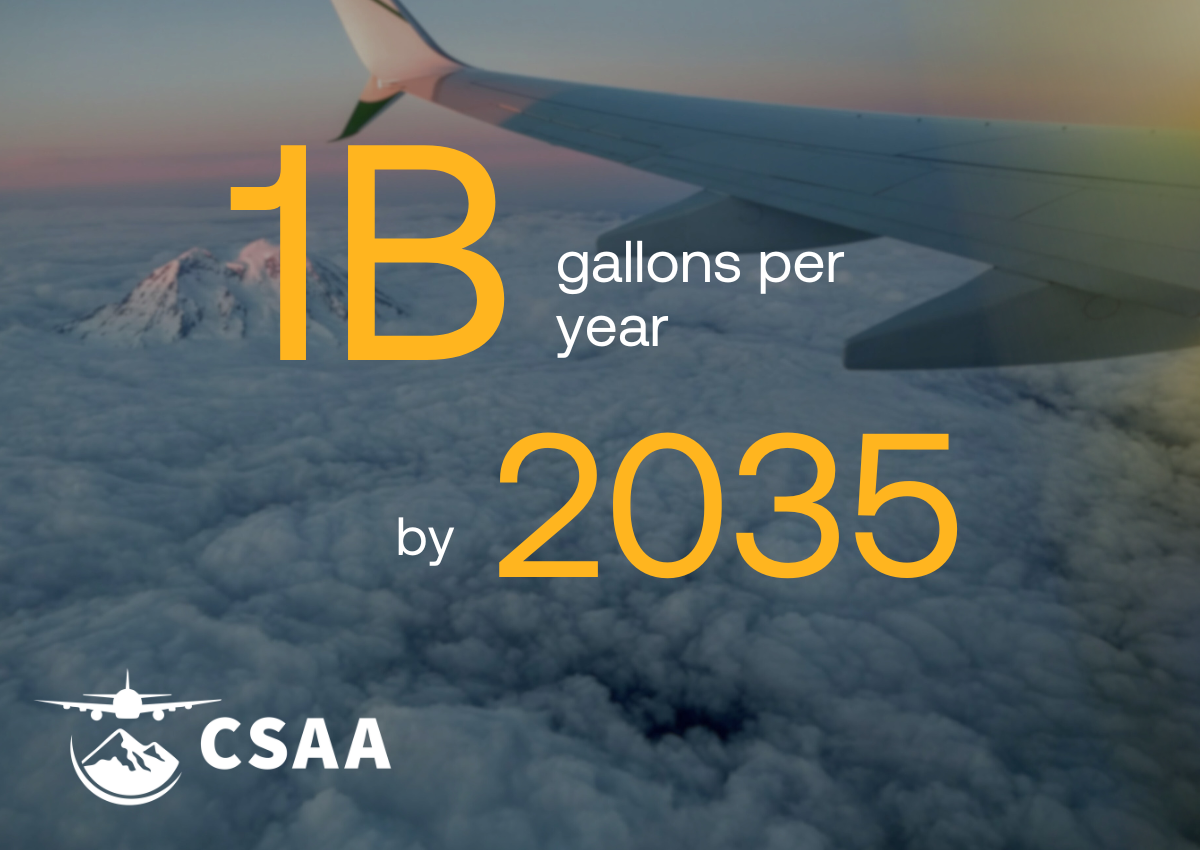
To rapidly accelerate SAF production and deployment and cultivate a prosperous local sustainable aviation economy, Earth Finance is convening a cross-sector coalition of stakeholders – the Cascadia Sustainable Aviation Accelerator (CSAA) with a shared goal of producing 1 billion gallons of SAF per year in the Pacific Northwest (PNW) by 2035.
Learn more about the launch of CSAA in the official press release.
This systems-level approach localizes solutions to the context of the PNW. It brings together the broadest group of stakeholders and expertise across the SAF value chain, from research and development to end user, to develop holistic solutions and build regional economic resilience for aviation.
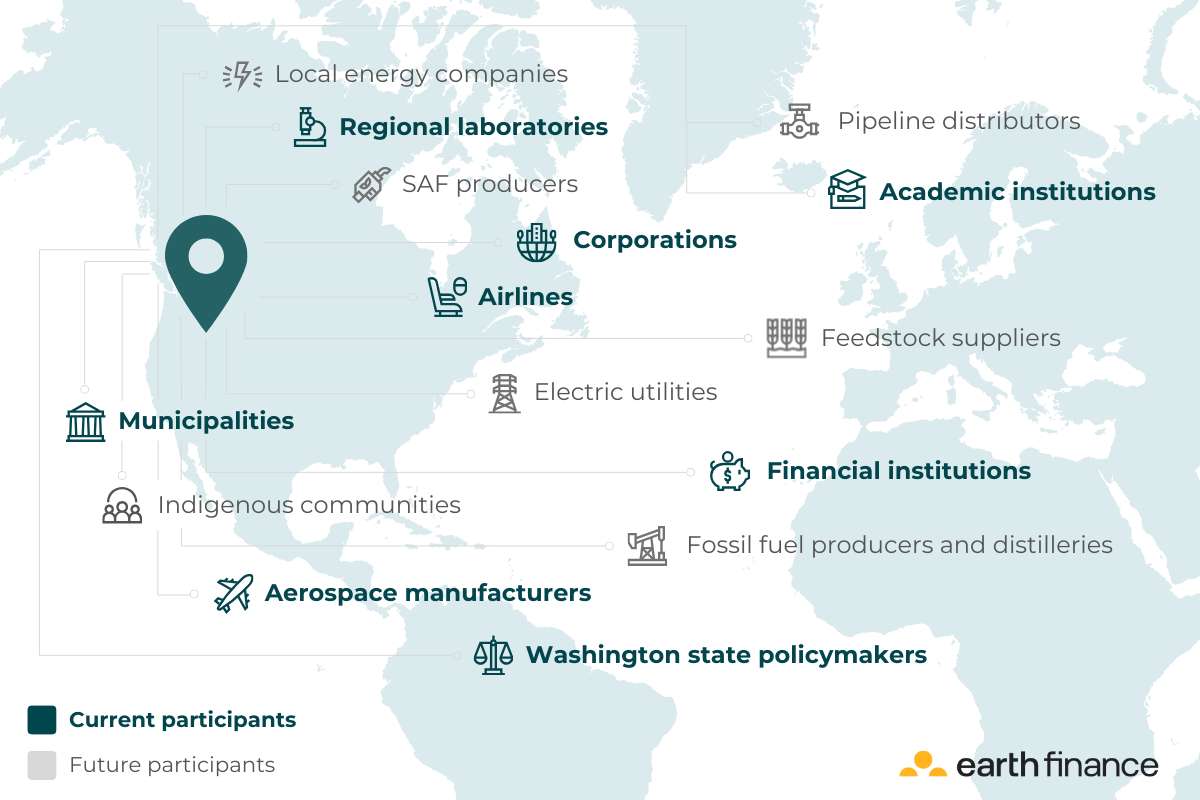
Participating coalition members currently include:
CSAA convenes a diverse community of stakeholders across the full SAF value chain:
The Pacific Northwest SAF landscape
Just like any other region, the PNW ecosystem offers a unique set of opportunities. In addition to being a hub of aerospace manufacturing and technology, the PNW has a favorable policy landscape to support SAF production, ready access to renewable energy, and an existing hub of fossil fuel refineries with equipment, workforces, and distribution systems translatable to SAF. Most significantly, the PNW has an abundant supply of woody biomass, enough to support 6 billion gallons of SAF production per year.
Some of the biggest challenges in the PNW are research and development and logistics. Compared to SAF production pathways like HEFA or alcohol-to-jet, the technology behind converting woody biomass to SAF is still emerging. There's also the question of transportation and logistics. How and where is woody biomass best collected, consolidated, and processed? Where should production plants be located? Should SAF be produced at the source then transported across the region, or should the feedstock be transported closer to major airports for production?
Our approach
To leverage the advantages and tackle the barriers of SAF production in the PNW and achieve its 2035 goals, we helped CSAA execute a 5-step framework for action leading up to its official launch on January 8, 2026:
Our team facilitated a workshop among participating coalition members to build an action plan across the 5 pillars of systemic change. Part of this workstream included understanding the interplay between pillars and the ideal sequencing within each to move the coalition’s goals forward. As mentioned above, embracing the SAF transition requires influencing all pillars of change. That said, they also need to be sequenced thoughtfully to achieve maximum impact.
For instance, in the PNW, policies like the Washington Climate Commitment Act help create a favorable market for SAF (if this isn’t the case in your region, the policy lever is a great place to start), but the technologies to support it are lacking. So, several interventions were identified to drive the policy changes needed to promote research and development of the PNW’s unique assets, including woody biomass.
Based on the prioritization of pillars determined above, Earth Financed helped CSAA develop policy and financing measures with specific interventions and resource requirements.
Next, we helped CSAA identify sources of financing and fundraising to support the implementation of initiatives. In addition to convening the coalition and facilitating the prioritization of work streams, Earth Finance, in partnership with Snohomish County, spearheaded the development of a sustainable business model for CSAA with input from all participating stakeholders.
To ensure the coalition makes its intended impact, our team helped formalize CSAA into a standalone entity with supporting governance structures to drive the work forward. As a functioning 501(c)(6) trade organization registered in the state of Washington, Earth Finance is now overseeing day-to-day operations and rapidly expanding the roster of coalition members in service of CSAA’s 2035 goals. The board of directors has also been expanded to include broad representation across municipalities, airlines, corporations, SAF producers, and more.
Our team facilitated a workshop among participating coalition members to build an action plan across the 5 pillars of systemic change. Part of this workstream included understanding the interplay between pillars and the ideal sequencing within each to move the coalition’s goals forward. As mentioned above, embracing the SAF transition requires influencing all pillars of change. That said, they also need to be sequenced thoughtfully to achieve maximum impact.
For instance, in the PNW, policies like the Washington Climate Commitment Act help create a favorable market for SAF (if this isn’t the case in your region, the policy lever is a great place to start), but the technologies to support it are lacking. So, several interventions were identified to drive the policy changes needed to promote research and development of the PNW’s unique assets, including woody biomass.
Based on the prioritization of pillars determined above, Earth Financed helped CSAA develop policy and financing measures with specific interventions and resource requirements.
Next, we helped CSAA identify sources of financing and fundraising to support the implementation of initiatives. In addition to convening the coalition and facilitating the prioritization of work streams, Earth Finance, in partnership with Snohomish County, spearheaded the development of a sustainable business model for CSAA with input from all participating stakeholders.
To ensure the coalition makes its intended impact, our team helped formalize CSAA into a standalone entity with supporting governance structures to drive the work forward. As a functioning 501(c)(6) trade organization registered in the state of Washington, Earth Finance is now overseeing day-to-day operations and rapidly expanding the roster of coalition members in service of CSAA’s 2035 goals. The board of directors has also been expanded to include broad representation across municipalities, airlines, corporations, SAF producers, and more.
With a concrete business model, governance structure, and action plan in place for CSAA, the coalition is now fully equipped to leverage the power of the multi-industry coalition and its combined capabilities to deliver systems-level solutions across the PNW.
The executive summary of the coalition's strategy will be available on the CSAA website in the coming weeks.
Key wins and outcomes
This initiative is lowering barriers to large-scale SAF production, enabling all members to capitalize on the SAF transition faster while delivering enormous economic value to the region:
- Airlines: Increased SAF availability, faster path to cost parity with fossil jet fuel, unique corporate partnership opportunities, optimized fuel infrastructure
- SAF producers: Improved offtake opportunities, enhanced access to capital, coordinated access to feedstock, energy, and infrastructure, collaborative permitting processes
- Airports: Improved air quality for local communities, access to next-generation sustainable aviation workforce
- Corporations: Reduced cost of SAF Scope 3 credits, enhanced brand value and competitive advantage
- Financial institutions: Derisked investment opportunities, multi-investor partnership potential, values-aligned climate investments
- Feedstock suppliers: Access to new customer channels and local, long-term revenue streams
Impact at a glance
14X
Economic value multiplier from every dollar invested in SAF production
7.5 million
Metric tons of carbon emissions abated by producing 1B gallons of SAF
4-6 billion
Annual SAF production (gallons) supported by PNW woody biomass
$500B+
Total predicted economic impact to the PNW region
Though still in its early stages, CSAA’s work has laid the foundation for executing its vision of rapidly accelerating SAF production in the PNW and delivering unmatched financial and environmental value to organizations across the value chain. In addition to defining a clear path to reaching its 2035 goals, the initiative has secured public and private funding and has formalized 2 functioning non-profits in the state of Washington, operated by Earth Finance, to lead this work going forward.
Over the next 3 years, the PNW must radically transform policy, energy, infrastructure, and market dynamics to set the stage for a regionally competitive and thriving next-generation renewable fuel economy. Leveraging the PNW’s unique comparative advantages with a systems-level, multi-stakeholder approach, the Cascadia Sustainable Aviation Accelerator is perfectly positioned to help create a self-supporting ecosystem for SAF.
Looking for a partner on your journey? Our team brings deep expertise in the policy, science, finance, and strategy landscape of the SAF ecosystem. Whether you’re taking a top-down or bottom-up approach to the SAF transition, we can help you translate the global challenges of SAF into the context of your region.