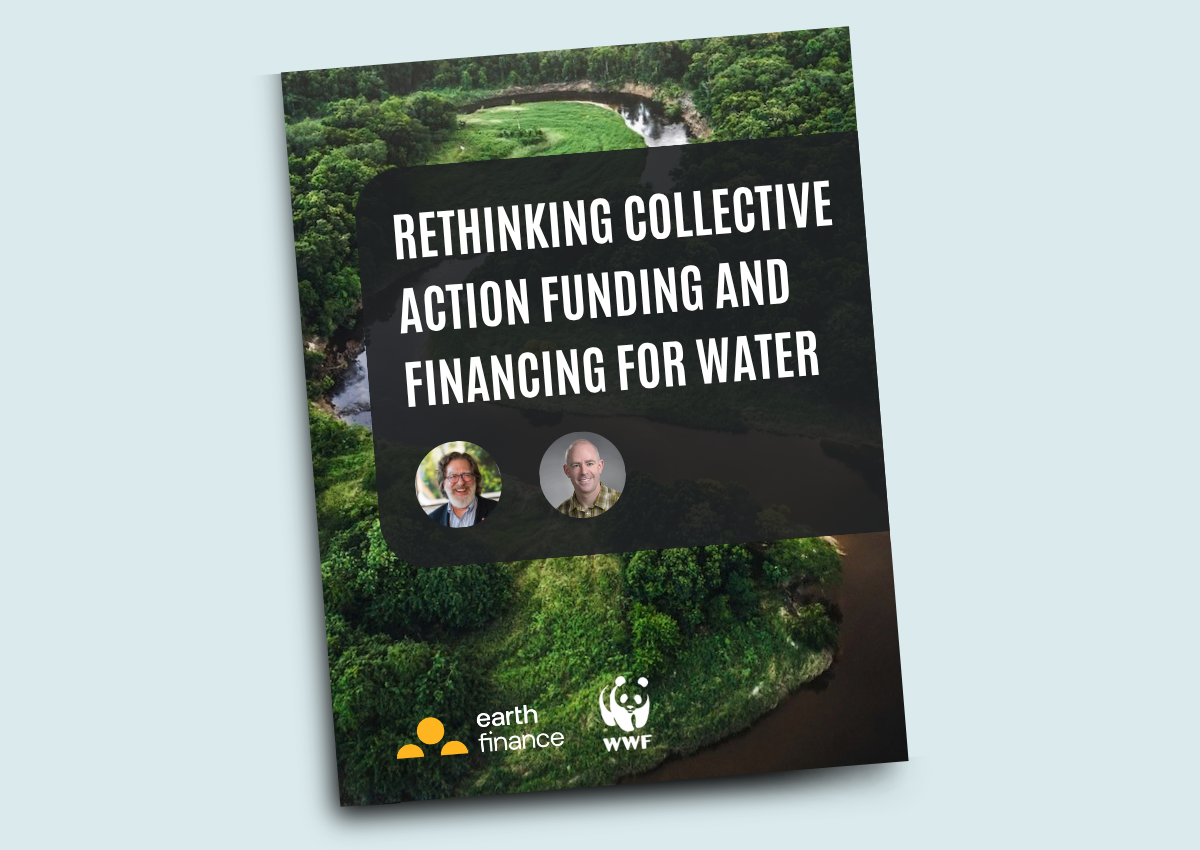
Why today's funding and financing models struggle to scale collective action, and how to fix it
We live in an era where water is increasingly recognized for its importance to society, business, and ecosystems, yet remains highly undervalued. And while collective action at the catchment level is seen as critical to mitigating shared water-related risks, funding and financing remains focused on small, bilateral projects.
This paper proposes a different architecture, moving the unit of action from the individual project to a locally governed catchment platform. It identifies options for revenue and capital stacks along with the financing structures that could transform collective action from isolated projects into cohesive platforms that can sustainably solve water challenges at scale. Inside the paper:
- Why funding and financing stays focused on small, bilateral projects.
- How to move the unit of action from the individual project to a catchment platform.
- How a platform's funding evolves from grants to participant contributions and transaction fees.
- The instruments that deploy capital: WOPAs, a layered capital stack, and a catchment resilience bond.
- How the framework could apply in practice to Mexico's Lerma-Chapala catchment.
Written in collaboration with WWF, and building upon the June 2026 WWF-GlobeScan report, Transforming Collective Action for Shared Water Challenges.