Reuven Carlyle
Garrett Kephart
Liat Carlyle
Tim Zenk
Erin Baldini
Kat Hunt
Chase Kania
Shaun Mitchell
Joanna Millstein
Will Sarni
December 2, 2026
What we got right about 2026, what surprised us, and 5 trends that will shape sustainability in 2027.
Foreword
We stand at an extraordinary inflection point in human history. As we march past the 1.5°C threshold, the physics, biology, and planetary boundaries that govern our world are no longer distant abstractions – they are the defining economic landscape of our time. For generations, market forces operated under an illusion that energy, water and other resources were infinite and free. Today, that curtain has lifted, revealing an undeniable truth: climate resilience, energy security, and natural resource stewardship are the bedrock of modern fiduciary duty and competitive advantage.
While concepts like space-based data centers spark the imagination for tomorrow, today’s leaders must navigate immediate, ground-level realities. Secure power, clean water, robust supply chains, and adaptive infrastructure are the real-world engines of economic growth. This transition represents the greatest value-creation opportunity of a generation.
Across the globe, communities and voters are demanding pragmatic, balanced solutions. As highlighted by Lowercarbon Capital following recent election cycles, people want protection from volatile energy costs alongside a shared stake in the infrastructure powering their futures. This signals a shift toward enduring, collaborative growth where innovation directly lifts local economies.
Geopolitical headwinds have laid bare the fragility of a disproportionate reliance on fossil-fuel systems. Yet still, market parity is already emerging in surprising places, from sustainable aviation fuel (SAF) growth toward cost competitiveness at key hubs to breakthrough circular business models. Capital is discovering that long-term sustainability is simply smart, resilient business.
Our message to executives for 2027 is one of deep optimism anchored in action: this is the time to lean in.
The fundamental science of Earth’s systems remains constant, and those who build for resilience today will capture the markets of tomorrow. We see a sustainable economy as a true win-win-win, uniting public well-being, policy, markets, investors, and bold innovation. Look no further than the Cascadia Sustainable Aviation Accelerator (CSAA). Supported by state leadership and over 30 coalition members, CSAA proves that aligning economic incentives across sectors accelerates systemic progress at scale.
And thought it all, place-based intelligence is where ambition meets execution. By integrating asset-level geospatial insights with rigorous financial modeling through Spatial Finance, organizations can deploy capital into water security, grid stability, and climate adaptation with unprecedented precision.
Building a thriving, circular, and climate-resilient world is the ultimate market opportunity. The choices we make now will resonate for generations. Let us lead with vision, purpose, and confidence.
Hon. Reuven Carlyle
EVP, Earth Finance
Washington State Legislator
(2009-2023)

Garrett Kephart
CEO, Earth Finance

2026 scorecard
Predictions are only useful if you hold yourself accountable. So before we dive into trends for 2027, let’s see how we did last year. Below, we grouped trends from our 2026 outlook into 10 themes and gave each a grade:
- On target: It happened, roughly as predicted.
- Still unfolding: It’s happening, but slower than expected.
- Partial credit: Part of it happened, or it happened differently than we said.
- Missed the mark: It didn't happen.
Five trends for 2027
1. Sustainability doubles down on pragmatism
Business performance in the real economy, particularly among commercial and industrial companies, was squeezed by tariffs, inflation, weather-driven supply chain disruptions, rising fuel costs, and shifting customer sentiment. Even with the “blue tsunami" seen during the recent midterms, sustainability teams are heading into 2027 with less money and more scrutiny over resource allocation.
Next year, investments will need to be ruthlessly prioritized, focusing on initiatives that deliver clear financial value to the business. For some teams, that could mean leveraging compliance as a stepping stone for longer-term goals. For example, Extended producer responsibility (EPR) rules can drive packaging innovation and near-term cost savings, and environmental disclosure requirements in California and the EU can become the groundwork for investments in adaptation and resilience.
This sentiment reflects the larger reckoning happening within the overall profession. In GlobeScan's 2026 survey of sustainability experts, nearly 60% said the current approach needs radical revision, and only 4% said it's working well. It also presents an opportunity for transformation. Teams that succeed in 2027 will be those that shift the sustainability narrative from mitigating risks to delivering business value, growth, and economic resilience.
2. Water enters the mainstream
New York Climate Week 2026 could have been called New York Water Week. In meeting after meeting, water came up as a material business risk and investment opportunity, particularly among investors who historically haven't focused on it.
Pure-play venture funds for water and ag-tech are raising money, and corporates are among the backers. For example, Emerald Technology Ventures reached $116 million for its latest Global Water Fund and Pureterra Ventures launched its second water tech fund with €10 million from Invest NL.
Corporations are also directly allocating capital toward water and ag tech. Most notably, Amazon launched the Colorado River Basin Collaborative in September, a coalition aiming to raise $100 million over 2 years alongside Aldi, The Coca-Cola Foundation, Ecolab, and Xylem. We expect more commitments like this in 2027, where corporations invest directly into vetted projects, from leak repair to AI-powered irrigation sensors, rather than a pooled fund.
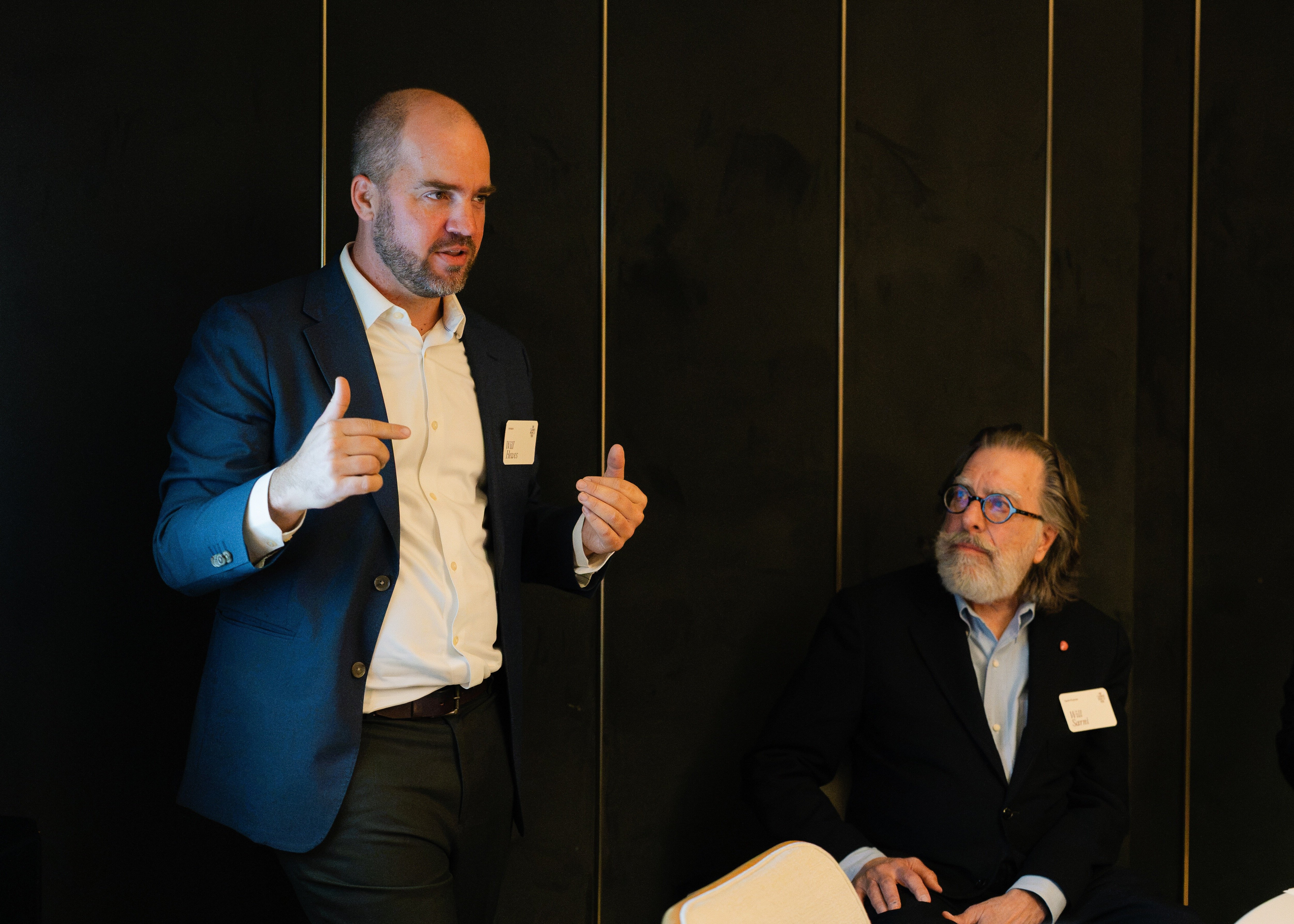
Will Hewes (Amazon) and Will Sarni (Earth Finance) discuss the Colorado River Basin Collaborative, launched during The Climate Pledge Hub at Climate Week NYC.
Similarly, we expect an increased focus on watershed-specific interventions, from collective action to technology solutions. After all, water risk and opportunity are hyper-local. A basin’s stress level, the farms in a supply shed, and the infrastructure serving a factory all vary by location, so the only credible way to quantify impact is real-time, place-based data. Companies that build that capability in 2027 will be the ones able to communicate the economic value of water directly to their CFOs, and gain sign-off for targeted investments as a result.
3. AI-built tools multiply, but trust in sustainability data erodes
LLMs have made it easy for anyone to build a business analysis tool in one sitting. In 2027, we anticipate sustainability will see a flood of vibe-coded solutions: dashboards, calculators, and risk screens built by individual teams with no governance or verifiable data.
We already see this with clients, where departments are building their own dashboards to bring internal data to life. However, these tools seldom scale beyond small internal teams, ladder up to corporate goals, or direct capital toward resilient infrastructure. Instead, they often lead to fragmented information – it's spreadsheets on steroids, not tooling for reliable decision-making.
There is a deeper risk worrying executives, too. When the expectation is to do more, and faster, people may stop applying the human expertise and rigour needed to use AI-outputs as the basis for corporate strategy.
Combine this with sliding sustainability commitments and the walk-back of international standards, and the quality of sustainability data could degrade substantially. For spatial intelligence in particular, the work still requires marrying two very different fields (geospatial data and financial reasoning) and it remains to be seen how useful vibe-coded tools are.
This isn’t to say that we need to curb AI adoption or stop building AI-generated software. Rather, it means that AI and vibe-coded applications must be paired with vetted data and documented methodologies. Setting clear governance, documenting where data comes from, and keeping humans in the review process is critical if AI-outputs are being used to drive multi-million dollar investment decisions. None of this is unique to sustainability, but sustainability decisions could be especially exposed.

Allocate capital wisely with SpatiaFiTM
SpatiaFi, launched just before New York Climate Week, combines asset-level geospatial data, financial modeling, and human expertise to support investment decisions executives can trust.

4. Renewable fuels have their moment
After years of production and adoption being somewhat limited to Clean Fuel Standard (CFS) markets in the United States, renewable fuels head into 2027 with federal and state policy moving in the same direction.
At the federal level, the EPA's final Renewable Fuel Standard rule for 2026 and 2027 made the largest increase in renewable fuel volume requirements in the program’s history. More required renewable diesel in the diesel pool, for example, means more revenue per gallon and plants running at full capacity. In 2027, producers should finally see sustained profitability.
New and strengthening state-wide policies will further accelerate progress. In California, renewable diesel now makes up nearly 75% of all diesel sold. California also legalized the sale of E15, gasoline blended with 15% ethanol, which could eventually cut pump prices by about 20 cents a gallon. In July, Hawaii became the 5th state with a Clean Fuel Standard. And in April, Kentucky passed a SAF tax credit of up to $3 a gallon, one of several states treating renewable fuels as a way to boost regional fuel resilience amid geopolitical turmoil. Washington also recently unlocked its SAF tax credit, which was signed into law in 2023, after in-state production capacity crossed 20 million gallons a year.
Our recommendations for companies across the renewable fuels value chain in 2027 are simple. Keep investing in regional initiatives, where the odds of system-wide change are highest, advocate for strategic policy, including programs like the LCFS and SAF tax credits, and don't let perfect be the enemy of good. Renewable fuels are available today and play a critical role in decarbonizing difficult to electrify sectors like heavy-duty transportation.
Jake Gentry (Earth Finance) introduces Governor Bob Ferguson during the inaugural Cascadia Leadership Summit.
Accelerating the SAF transition
Earth Finance is proud to support the Cascadia Sustainable Aviation Accelerator (CSAA). Launched in January with the governor’s support, CSAA now brings together 30+ producers, airlines, ports, and public agencies to turn incentives like Washington’s SAF credit into regional production, with a goal of 1 billion gallons a year by 2035. Explore CSAA.

5. Carbon-free energy commitments soften
We expect hyperscalers and commercial and industrial companies to redefine their carbon-free energy (CFE) commitments or lengthen their timelines. Most corporate CFE goals were set to prepare for expected climate legislation, save money, hedge against grid and fossil energy prices, and/or align with the “zeitgeist” of public and political opinion.
Minus the hedge against grid-sourced energy, most of these factors are no longer relevant. That makes CFE commitments more expensive to keep and easier to revise. Microsoft, for example, is considering dropping its goal of matching 100% of its hourly electricity use with clean energy due to AI-driven demands.
For data centers, the goal is finding power faster (be it brown or green), which has increased the appeal of natural gas, fuel cells, or even turbine-powered generators. The silver lining is that solar is still the cheapest new power available, and can be built faster. In fact, solar power made up 51% of new utility-scale electricity capacity planned this year. Texas alone accounts for 40% of that planned solar capacity.
The constraint is batteries. Integrating more solar into the grid takes storage, and storage costs have risen nearly 30% since 2020. Additionally, U.S. manufacturing still relies on Chinese supply chains. That said, tech companies’ willingness to deploy massive amounts of capital to scale AI infrastructure may be what finally drives creative solutions, such as a larger U.S. battery manufacturing base.
Unleash the power of sustainable economic growth.
Earth Finance pairs high-value strategy with geospatial technology to help organizations surface risks and design pragmatic, sustainable growth strategies.
Get in touch